
Understanding Binary Coded Decimal Basics and Uses
Learn how Binary Coded Decimal (BCD) works ⚙️, its types, uses in digital systems 💻, pros & cons, and comparisons with other numbering formats 📊.
Edited By
Sophie Bennett
Binary Coded Decimal (BCD) is a method of representing decimal numbers where each decimal digit—from 0 to 9—is encoded into its own binary form. Unlike traditional binary numbering, which treats the entire number as a whole, BCD deals with each digit separately in a fixed group of bits, usually four. This means the decimal number 45 translates to two sets of four-bit binary numbers: 0100 for 4, and 0101 for 5.
BCD’s distinct structure makes it a favourite in fields where decimal accuracy matters, such as financial computing and electronic displays. In Nigeria, where many traders and finance professionals rely on digital systems for transactions and record-keeping, understanding BCD helps in grasping how devices like Point of Sale (POS) terminals and banking software handle numbers.
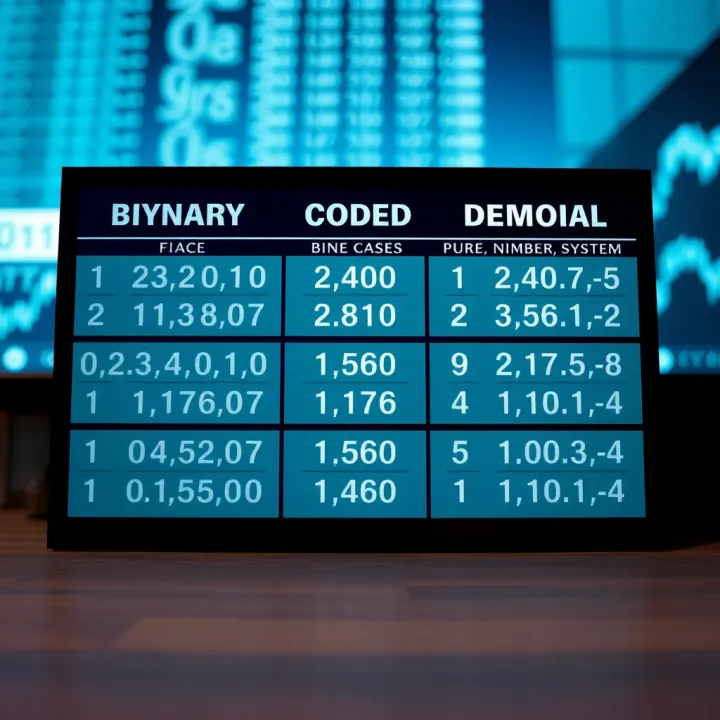
BCD keeps decimal digits intact during processing, which avoids rounding errors common in straight binary conversions, ensuring accuracy in financial calculations.
Each decimal digit maps individually to a 4-bit binary number.
The binary digits for 0-9 range from 0000 to 1001.
BCD codes don’t use binary numbers from 1010 to 1111, which are invalid for decimal digits.
For example, to represent the number 293, BCD assigns 0010 (2), 1001 (9), and 0011 (3) respectively. This approach preserves the decimal structure during computations.
Banking and Finance Software: Calculations involving money require exact decimal representation. BCD prevents errors when summing or multiplying currency values.
Electronic Meters: Devices measuring electricity or water consumption often display results in decimal digits powered internally by BCD.
Digital Clocks and Calculators: They use BCD internally for simpler interpretation and display of decimal numbers.
In a country where financial transactions and measurements depend heavily on digital systems, BCD’s reliability makes it a key technology, even if most users don’t see it directly.
Understanding BCD equips traders, investors, brokers, and analysts with insight into how numbers are manipulated behind the scenes, helping them trust digital financial tools better and troubleshoot when issues arise.
Binary Coded Decimal (BCD) is a way of representing each decimal digit of a number using its own specific group of binary bits. Instead of converting a whole number into a continuous string of binary digits like in pure binary, BCD breaks the number down digit-by-digit. This makes BCD particularly useful in environments where human-readable decimal numbers are necessary but electronic systems rely on binary.
BCD encodes decimal digits so each one is stored as a separate unit, usually with four bits. The key purpose here is to bridge the gap between human-friendly decimal numbers and machine-friendly binary data. In practical terms, this means numbers displayed on digital devices like calculators or clocks remain accurate and easy to interpret internally without complex binary-to-decimal conversions during output.
Consider a trader tracking stock prices in naira. If the system used pure binary for calculations, extra steps would be needed to convert the results back to naira amounts in decimal, increasing processing load. BCD keeps the digits discrete, ensuring correctness and ease of display.
Each decimal digit from 0 to 9 is expressed in binary using four bits. For example, the decimal number 47 breaks down into two digits: 4 and 7. The digit 4 converts to 0100 and 7 to 0111. These pairs are stored side by side as 01000111 in BCD. This preserves the original decimal structure distinctly unlike continuous pure binary which would represent 47 as 101111.
This separation helps avoid rounding errors common in pure binary when handling decimal numbers like currency or measurement values.
BCD’s format means systems handling financial data, like banking software in Nigeria, can work with numbers and present them naturally to users. On top of that, BCD simplifies the design of digital displays requiring numeric output.
To sum up: BCD focuses on reliable representation of decimal digits in binary, maintaining their individuality rather than cramming all digits into a hefty binary chunk. This is particularly handy in fields like finance, trading, and business analytics where precise decimal handling is crucial. Understanding BCD not only helps traders and analysts appreciate the data's structure but also shines light on why some electronic devices perform certain number operations the way they do.

Understanding how Binary Coded Decimal (BCD) works in practice is essential for grasping its role in computing, especially in finance and trading where accuracy matters. BCD translates each decimal digit into its binary form, typically using four bits. This differs from pure binary representation, which encodes the full number as a single binary value. The practical advantage here is that BCD preserves decimal digit boundaries, which simplifies operations like displaying numbers or performing decimal-based calculations.
Converting decimal numbers to BCD involves taking each decimal digit and representing it with a fixed four-bit binary code. For example, the decimal number 59 would be split into digits 5 and 9. Digit 5 in binary is 0101, and 9 is 1001. Together, 59 in BCD becomes 0101 1001.
This process is straightforward but must be done digit by digit rather than converting the entire number into a binary equivalent. In Nigerian financial software or digital displays at banks, you’ll often find BCD used because it ensures digit accuracy without the rounding errors seen with floating-point binary.
Reversing BCD to get the original decimal number is just as simple. Each group of four bits maps back to a single decimal digit. For example, 0011 represents 3, and 0111 represents 7. When combined, 0011 0111 translates back to 37.
This back-and-forth conversion helps systems display monetary amounts or stock prices exactly as entered. Consider a broker using trading software to view share prices; BCD helps prevent misrepresentation caused by binary rounding, essential in the Nigerian stock market where precision is vital.
Let’s say a digital clock in Nigeria’s timekeeping systems shows 12:45. BCD stores the hour digits '1' and '2' separately in binary form as 0001 and 0010, while the minutes '4' and '5' are 0100 and 0101. This clear separation eases both display and arithmetic operations on time.
Another example is in calculators. When you enter 123, each digit is encoded in BCD (0001 0010 0011). This method allows the calculator’s processor to manipulate each decimal digit effectively, avoiding binary-to-decimal conversion errors.
BCD's strength lies in its simplicity and accuracy when handling decimal digits one by one, which matters most in financial calculations and display systems like clocks and calculators.
In summary, BCD’s practical use involves simple conversions that maintain digit integrity. For traders and finance professionals dealing with precise numbers, knowing this conversion process helps appreciate why some systems prefer BCD over pure binary.
Binary Coded Decimal (BCD) finds its strength where representing decimal digits exactly is necessary. Unlike pure binary, BCD preserves each decimal digit in a fixed four-bit pattern, making it ideal for applications that require precise and readable decimal data. This characteristic makes BCD valuable in various fields, especially in technology areas where human interaction or exact decimal values matter.
Digital clocks and calculators heavily rely on BCD for their display and internal logic. These devices have to show time or calculations in a format users instantly recognise — standard decimal numbers. BCD allows the system to convert each decimal digit into binary data accurately without the risk of rounding errors common in floating-point binary formats.
For example, a digital clock showing '12:45' will store each digit ('1', '2', '4', '5') in separate four-bit BCD codes. This method simplifies the task of driving seven-segment displays, frequently found in these devices, since each digit corresponds directly to a BCD nibble (4-bit group). Calculators working with money and measurements use BCD to ensure results are exact and not distorted by binary conversion errors.
In financial sectors, including banking and trading, precise decimal representation is non-negotiable. BCD eases handling of currencies — like the Nigerian Naira — where every naira and kobo counts. Systems processing invoices, payrolls, stock trades, and tax calculations often employ BCD to avoid discrepancies that may arise from binary rounding.
Accounting software, electronic point-of-sale (POS) devices, and financial calculators typically store and manipulate numbers in BCD because it ensures that operations such as addition, subtraction, and interest calculation yield accurate decimal outcomes. This reliability is critical in environments like the Nigerian Stock Exchange or local banks where small errors can lead to significant financial loss or compliance problems.
BCD offers a surefire way to keep decimal accuracy intact, a must-have for devices and systems that deal with monetary values or time-sensitive data.
Overall, the practical benefits of BCD make it relevant beyond legacy tech. In Nigeria’s fast-evolving fintech space, integrating BCD into hardware and software ensures better accuracy and user trust, especially where naira calculations and display clarity are priority. From simple digital watches to complex financial systems, BCD serves as a dependable backbone for handling decimal numbers precisely.
Binary Coded Decimal (BCD) offers clear benefits, especially in applications where accurate decimal representation matters. For traders and investors working with financial data, BCD ensures that decimal digits translate directly into binary without rounding errors. This precision is vital when dealing with currency amounts, stock prices, or interest rates – areas where even a small error can cost millions.
One practical benefit is the simplicity in displaying decimal numbers on digital devices like electronic price tickers or calculators. Since each decimal digit is stored separately as a 4-bit binary number, converting to human-readable form becomes straightforward. For example, a calculator used by a stockbroker in Lagos displays prices like ₦2,450.75 exactly, avoiding the confusion that sometimes occurs with pure binary floating-point representations.
Moreover, BCD makes arithmetic operations involving decimals more intuitive. In accounting software and fiscal systems, especially those locally developed or customised for Nigerian banking, BCD helps avoid binary-decimal conversion errors. Its structured format also assists in easing debugging and error detection when programming, leading to lower chances of misrepresenting financial figures in reports.
Despite its benefits, BCD has significant efficiency drawbacks when compared to pure binary representation. Storing one decimal digit with four bits wastes space since a 4-bit nibble can represent up to 16 values, but BCD limits it to 10. This means BCD uses nearly 40% more bits than necessary for the same number, which can be costly in memory and processing.
These inefficiencies are more apparent in systems handling large volumes of data, such as financial exchanges or big data analytics firms in Nigeria. Pure binary formats allow faster mathematical computations and more compact storage, which leads to quicker processing times and reduced operational costs. For instance, a high-frequency trading platform primarily uses binary for speed and memory efficiency, and only converts to BCD when presenting data.
Another limitation is the extra logic needed for arithmetic operations in BCD. Unlike binary addition or subtraction, BCD arithmetic requires correction steps to stay within decimal bounds. This increases circuit complexity and can slow down processors, especially in embedded systems or low-power devices common in Nigerian fintech startups.
While BCD ensures decimal accuracy, it does so at the expense of memory and processing efficiency, which is why its use tends to be limited to specific financial and display applications rather than general computing.
In summary, BCD strikes a balance between readability and accuracy versus efficiency. For Nigerian finance professionals, software engineers, and analysts, understanding where BCD fits is key to leveraging its strengths without falling victim to its limitations.
Understanding how Binary Coded Decimal (BCD) stacks up against other numerical systems gives you a clearer picture of where it fits in practical computing and financial applications. This comparison matters, especially for traders, analysts, and finance students, who deal with data representations that influence precision and efficiency in calculations.
The pure binary system simply converts whole numbers into a string of bits, using base-2. It packs numbers tightly, so it is usually more efficient in terms of storage and processing speed. However, it doesn't represent each decimal digit explicitly. This can lead to rounding errors in financial calculations, because computers use approximations when converting decimals to binary fractions.
BCD, on the other hand, keeps each decimal digit separate as a four-bit binary block. For example, the decimal number 59 in BCD is written as 0101 1001, representing '5' and '9' individually, instead of a single binary number 111011. This makes BCD especially useful for financial software where exact decimal representation matters. You won’t lose accuracy when dealing with naira amounts or stock prices.
That said, BCD requires more bits to store the same number — it’s less space-efficient and can slow down computation relative to pure binary. In Nigeria's financial sector, this trade-off is accepted sometimes because accuracy in monetary values outweighs raw speed, for instance in banking software or POS transaction systems.
Hexadecimal (base 16) and octal (base 8) systems are mainly favoured in computing for compact binary representation and ease of human reading. Hex uses 16 symbols (0–9, A–F), which map neatly to four binary bits, while octal uses eight symbols (0–7), each representing three bits.
Unlike BCD, hexadecimal and octal don’t correspond directly to decimal digits, so they are less ideal for applications needing exact decimal digit preservation. For example, a hexadecimal representation of a money figure like ₦75,000 lacks the straightforward digit-to-bit mapping that BCD offers, risking subtle errors if conversions are mishandled.
Still, hex and octal are superb for programming, memory addressing, and low-level computations. Nigerian software developers working on system drivers or embedded devices often use hex because it interfaces neatly with machine code.
In essence, BCD is chosen for precision in decimal digit handling, especially valuable in finance, while hex and octal serve better in processor-oriented tasks where compactness and speed are priorities.
When deciding which system to use, consider your application's needs: if you handle pure data computation with no strict decimal accuracy, pure binary or hex is generally faster and more efficient. But if you’re coding a banking app where every kobo counts, BCD’s accuracy is worth the extra bits.
In the Nigerian context, where the accuracy of financial data is crucial but hardware resources may not be unlimited, understanding these trade-offs helps developers and finance professionals select the right tool for their software or analysis.
Learn how Binary Coded Decimal (BCD) works ⚙️, its types, uses in digital systems 💻, pros & cons, and comparisons with other numbering formats 📊.

Master binary multiplication in easy steps! Learn how base-2 maths works, see real computing uses, and get practical tips for handling this vital digital skill 💻✍️
Learn how to convert 45 from decimal to binary with clear steps and practical examples. Understand binary basics and see why it matters in tech and everyday life 💻⚙️

💻 Explore how binary format shapes computing and data storage, learn binary number basics, applications, and clear up common misconceptions in tech.
Based on 12 reviews