

Understanding Binary Format Explained
💻 Explore how binary format shapes computing and data storage, learn binary number basics, applications, and clear up common misconceptions in tech.
Edited By
Oliver Grant
Binary numbers form the backbone of modern computing and digital technology. For traders, investors, and analysts who work closely with complex computing systems or financial algorithms, understanding how numbers translate into binary can improve your grasp of how data is processed behind the scenes.
The decimal number 45 is a straightforward example to demonstrate how to convert base-10 numbers into their binary equivalents. This helps demystify how computers represent and manipulate data, something that can be especially relevant when dealing with programming, financial modelling software, or even bespoke trading algorithms.

Binary uses only two digits: 0 and 1. Each digit in a binary number represents an increasing power of two, from right to left. Unlike the decimal system—which relies on powers of ten—binary captures information in a way machines easily understand.
Knowing how to convert numbers like 45 into binary equips you with foundational knowledge of data encoding, which is a significant part of financial technologies and market analysis tools.
Here's a quick overview of why binary matters:
Precision in computing: All digital systems, from trading platforms to mobile apps, interpret data in binary.
Understanding algorithms: Many financial algorithms work on binary logic operations.
Data storage and transmission: Stock price feeds or portfolio data get stored and transmitted in binary format.
By breaking down the decimal number 45 into binary, you’ll see the step-by-step process behind this number system. It’s a skill that not only builds technical literacy but also sharpens your analytical capabilities when dealing with digital financial tools.
Next, we'll cover how 45 converts into binary through simple division steps and explain the practical applications relevant to you.
Understanding the basics of binary numbers is essential, especially when dealing with digital data and computing. Binary is the language computers speak; every instruction, image, and video on your phone or laptop is ultimately represented in binary. Knowing how this system works offers clarity on how electronic devices process information, making it easier for traders or analysts dealing with data and technology-driven finance.
The binary number system uses only two digits: 0 and 1. Unlike the decimal system, which uses ten digits (0 to 9), binary relies on these two symbols to represent all numbers. Each position in a binary number corresponds to a power of two, starting from 2⁰ at the rightmost end. For example, the binary number 1011 equals:
1 × 2³ = 8
0 × 2² = 0
1 × 2¹ = 2
1 × 2⁰ = 1
Adding these gives 8 + 0 + 2 + 1 = 11 in decimal.
This system is quite efficient for electronic circuits, which have two clear states: on or off. Hence, binary perfectly matches how circuits operate by using 0 for off and 1 for on.
The decimal system, which we use daily, is base 10 and includes digits from 0 to 9. Each digit represents powers of ten, depending on its position. For example, the decimal number 45 breaks down as:
4 × 10¹ = 40
5 × 10⁰ = 5
So, 45 = 40 + 5.
In contrast, the binary system is base 2. Because it has only two digits, numbers tend to occupy more “space” in binary compared to decimal. For instance, the decimal 45 is represented as 101101 in binary:
1 × 2⁵ = 32
0 × 2⁴ = 0
1 × 2³ = 8
1 × 2² = 4
0 × 2¹ = 0
1 × 2⁰ = 1
Adding these gives 32 + 0 + 8 + 4 + 0 + 1 = 45.
For practical purposes, knowing this difference helps in understanding how digital devices convert familiar decimal figures into machine-understandable binary.
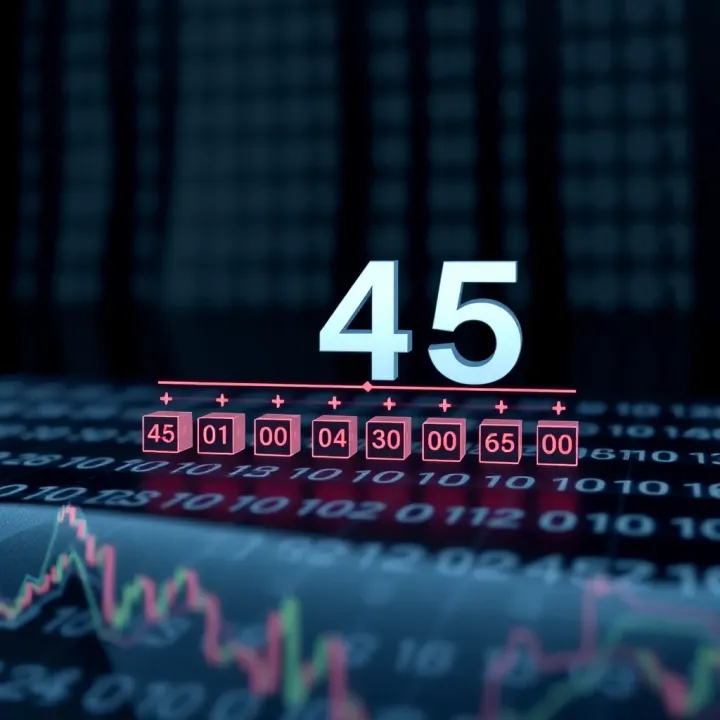
To sum up, understanding binary helps demystify how numbers are handled behind screens and digital platforms you often interact with, be it in fintech apps or stock market software. This knowledge helps you appreciate the simplicity and efficiency of using just two digits to represent complex information digitally.
Understanding how to convert 45 from decimal to binary is useful, especially for finance students, traders, and analysts who deal with digital systems and computer-based data processing. Binary representation lies at the heart of computing, so knowing this conversion helps you grasp how computers interpret and manipulate numbers. This knowledge can come in handy when working with financial software, cryptography, or even programming algorithms for trading.
The most straightforward way to convert 45 into binary is the division by two method. This technique involves repeatedly dividing the decimal number by two and noting the remainder at each division until the quotient reaches zero. For example, if you divide 45 by 2, you get 22 with a remainder of 1. Then, you divide 22 by 2, the quotient is 11 and the remainder is 0. You keep going like this:
45 ÷ 2 = 22 remainder 1
22 ÷ 2 = 11 remainder 0
11 ÷ 2 = 5 remainder 1
5 ÷ 2 = 2 remainder 1
2 ÷ 2 = 1 remainder 0
1 ÷ 2 = 0 remainder 1
Now, collect the remainders from bottom to top: 101101. That means 45 in binary is 101101.
Another effective way is to use the place value method. Think of this as comparing 45 against powers of two — 32, 16, 8, 4, 2, and 1. Start with the largest power of two less than or equal to 45, which is 32:
Does 32 fit into 45? Yes. So, put 1 in the 32’s place. Subtract 32 from 45, leaving 13.
Next is 16. Does 16 fit into 13? No. So, 0 in the 16’s place.
8 fits into 13? Yes. Put 1 there. Now 13 minus 8 = 5.
4 fits into 5? Yes. Put 1 there. 5 minus 4 = 1.
2 fits into 1? No. So, 0 in the 2’s place.
Finally, 1 fits into 1? Yes. Put 1 there.
Putting those bits together gives 1 0 1 1 0 1 — again, 101101.
Both methods give the same binary number, but the division method is often easier for quick conversion, while place value provides better insight into how binary digits represent decimal amounts.
Knowing these approaches builds a solid foundation for understanding binary and how machines work with numbers. For traders and analysts, this means better command over digital tools and data encoding formats used in modern finance.
Understanding the step-by-step conversion of a decimal number like 45 to its binary counterpart is essential for grasping how computers and digital devices process information. Unlike decimals, binary uses only two digits – 0 and 1 – to represent values. This stepwise approach not only clarifies how the binary system works but also sharpens skills that traders, analysts, and finance students can use to appreciate data encoding, machine-level operations, or even algorithmic logic when working with digital finance platforms.
The most common way to convert 45 into binary is by dividing the number repeatedly by two and noting the remainders. Here’s how it plays out practically:
Divide 45 by 2, which gives 22 with a remainder of 1.
Divide 22 by 2, resulting in 11 with a remainder of 0.
Divide 11 by 2, giving 5 with a remainder of 1.
Divide 5 by 2, which equals 2 with a remainder of 1.
Divide 2 by 2, resulting in 1 with a remainder of 0.
Finally, divide 1 by 2, which is 0 with a remainder of 1.
These division steps are important because each remainder forms part of the binary number—either a 1 or a 0—representing whether the number is odd or even at each division level.
Once you’ve recorded the remainders from each division step, you read them from bottom to top (the last remainder is the most significant bit). For 45, the remainders listed from the final division upward are:
1 (from 1 ÷ 2)
0 (from 2 ÷ 2)
1 (from 5 ÷ 2)
1 (from 11 ÷ 2)
0 (from 22 ÷ 2)
1 (from 45 ÷ 2)
Putting them together, the binary form of 45 is 101101.
This stepwise approach equips you with a hands-on method to decode decimal numbers at the binary level, a skill worth mastering for anyone familiar with financial modelling, algorithmic trading, or understanding how digital banking platforms manage data.
Knowing how to perform this conversion also builds foundational knowledge for deeper topics like data encryption, network communication, and computing hardware operations, all of which lean heavily on binary logic. Plus, having this understanding lets you interpret reports or tools that might represent data in binary or related systems without getting lost in technical jargon.
Binary is the foundation of how modern technology operates. At its core, binary represents information using only two digits: 0 and 1. This simplicity allows electronic devices to process data reliably, even with the physical challenges of voltage fluctuations or signal noise common in electrical circuits. Understanding why binary matters demystifies how everything from computers to smartphones works behind the scenes.
Electronic devices, including computers, use binary because their internal components can easily represent two states—on and off. Transistors, the tiny switches inside processors, switch between these two conditions to perform logical operations. This binary approach makes it easier to design complex circuits for calculations, data storage, and communication.
For instance, the Central Processing Unit (CPU) translates instructions into binary code to execute commands. Binary also simplifies internet data transmission; when you send a message or browse a webpage, the information travels as a stream of binary signals across cables and wireless networks.
Binary is not just a number system; it’s the language of electronic circuits, making high-speed calculations and digital communication possible.
The impact of binary is everywhere in daily life. Your ATM card, for example, uses a chip that processes your Personal Identification Number (PIN) and transaction data in binary. Smartphones store photos and videos as binary files, decoding this data to display your memories clearly.
In transportation, modern cars employ digital systems powered by binary-coded instructions to manage engine performance and safety features. Even your favourite nokia tokunbo phone, once popular for durability, relies on binary to handle calls and text messaging.
Digital payment platforms like Paystack and Flutterwave also operate on binaries behind the scenes. When you make a transaction of ₦5,000, your bank's system converts this amount into binary code, processes it, then confirms the payment right to your phone screen.
Understanding binary helps you appreciate the technology that makes life smoother and business transactions faster in Nigeria and beyond. It underpins everything from basic coding to complex fintech solutions.
By grasping binary, traders and analysts can better understand how data systems function, supporting sharper decisions in digital finance environments. This knowledge gives you a clearer view of the tech that drives today’s economy.
Grasping the concept of binary numbers can be tricky for many, especially those who are accustomed to the decimal system. The differences between the two systems often cause stumbling blocks, with some common challenges standing out. Understanding these issues is crucial for traders, analysts, and finance students who often deal with digital data, computing systems, or even fintech solutions where binary logic underpins operations.
One major challenge is misinterpreting place values in binary. Unlike decimal numbers, which use base 10, binary uses base 2. This means each position represents a power of two instead of a power of ten. For example, the rightmost bit represents 2⁰ (which equals 1), the next bit to the left represents 2¹ (2), then 2² (4), and so on.
This shift often confuses learners. Consider the number 45, which in binary is 101101. Each bit indicates whether a power of two is present (1) or absent (0). Misreading these place values may lead someone to treat binary as decimal, resulting in wrong conversions. For instance, interpreting the binary 101 as "one-zero-one" or 101 decimal instead of its true value (5 in decimal) causes errors.
Such mistakes can ripple in financial computations, fintech product design, or analytical modelling where binary data counts. It’s common to get tangled between the significance of each digit’s position if one does not internalise how base-2 arithmetic works.
Practising structured conversion methods helps overcome these confusions. Always start with small, familiar numbers like 5, 10, or indeed 45, and convert them manually using the division-by-two method. Writing down the remainders clearly and then reading the binary from bottom to top anchors the concept concretely.
Another helpful approach is to memorise the first eight powers of two (1, 2, 4, 8, 16, 32, 64, 128). This makes it easier to work backward from a decimal number to its binary equivalent by subtracting the largest suitable power of two at each step.
Try explaining the conversion process aloud or teaching it to a peer, which compels your brain to organise the steps logically. Smartphone apps or online binary converters also provide immediate feedback, letting you compare your manual work with automated results.
Mastering binary conversion strengthens your foundational computing knowledge. In the Nigerian fintech scene, where platforms like Paystack and Flutterwave thrive, understanding binary helps one better appreciate how digital transactions and data operations are encoded and handled behind the scenes.
💻 Explore how binary format shapes computing and data storage, learn binary number basics, applications, and clear up common misconceptions in tech.
🔢 Learn binary addition step-by-step with clear examples and essential rules. Discover its role in digital systems and avoid common mistakes! 💻

Explore binary operations in math ➕✖️: their definitions, properties, and uses in algebra, computer science, & logic. Perfect for learners in Nigeria 🇳🇬.

🔢 Explore binary operations in math & CS: definitions, types, properties & practical examples to boost your problem-solving skills with ease! 💡
Based on 11 reviews